Oakist Press - Book review
Earth Magic
A review of Nature Boy's Magical World by Steve Andrews
By Chris Stone
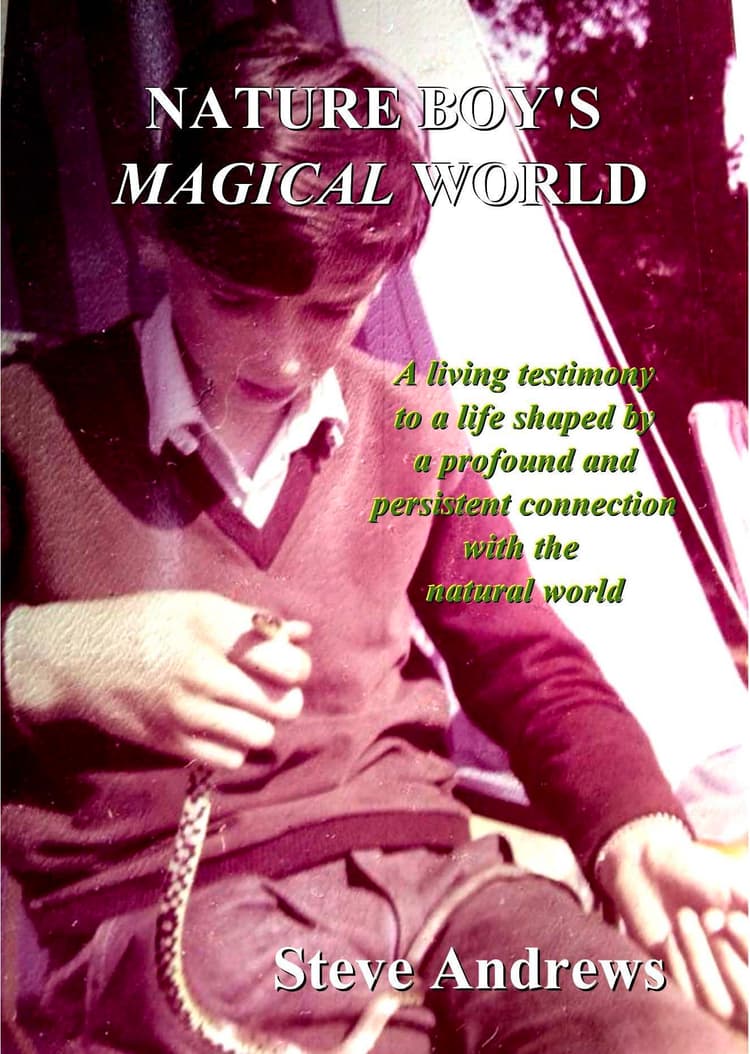
Full disclosure. Steve Andrews, the author of this book, is one of my oldest friends. We’ve known each other since 1971, when I first went to University in Cardiff. Steve was a local, having been brought up in Llandaff, a posh suburb on the outskirts of the city.
We are the same age, both born in 1953. Steve is a little older than me, having arrived in the world in March, while I popped out in June. He was born on the equinox, while my birthday is near to the solstice.
We grew up in the same ethos. Young hippies, looking to the recent stirrings in California in the mid-sixties for inspiration. Peace, love and Rock’n’Roll. Drugs. Psychedelia. Flares. Long hair. Trench coats. Tie-dye. Spirituality. Wholefood. All that shit.
We took to each other immediately and were soon sharing a flat. It was me and Steve and another friend, Dave. Dave and I were both at college, while Steve worked.
We were up late at night, like the inconsiderate youngsters we were, keeping the guy downstairs awake. I remember him standing on the bottom of the stairs shouting up at us. “Fucking shut up, will you? Some of us have got to be up for work in the morning.”
And then Steve standing on the top of the stairs shouting down: “Well I’m working too, and I don’t care.”
Our lives centred around drugs, music, alcohol and parties, and I didn’t really get to know Steve properly till many years later. That’s when I discovered his secret passion. Whenever we went for a walk, he’d be showing me the wildlife.
He’d tell you what plants you could eat. He could recount their medical properties. He was constantly stopping to look, pointing at this or that, making observations about the state of the world. There was a characteristic pose he’d assume. He’s tall, over six foot, and he wears glasses. He would stoop to pick something up, and then remove his glasses to look at it. The way he studied the object in his hand was both technical and worshipful at the same time. He combined the observational skills of a scientist with the reverence of a priest. On the beach he would lift up rocks to see what was underneath. In the park he would watch the squirrels and observe the plants. He was aware of all the life around him. And then, when you went to his house, it too was full of living creatures. Lots of peculiar plants, many of them of the psychedelic variety, plus beady eyed beings in aquariums – axolotls, exotic fish and stick insects – and a variety of other weird and wonderful presences.
I was writing for a living by then. I suggested he could take up nature writing. Later we shared a fortnightly column in the Big Issue Cymru. He would contribute one week, and I would contribute the next. It was here that he acquired the title The Bard of Ely, after the estate he lived on at the time.
It was through Steve that I became acquainted with King Arthur, with whom I wrote my book, The Trials of Arthur.
He never seemed to fit in with the ordinary world. He was always getting himself into trouble, usually by going along with other people’s madcap schemes. He was very easy to manipulate. He got into my car once and I asked him to do up his seatbelt. He looked at me as if he didn’t know what I was talking about, as if the concept of “seatbelt” was beyond his realm of experience. I had to lean over and do it up for him.
I used to joke that he was like an alien being from another planet. Later, when I saw how comfortable he was in the natural world, how well he fitted in, I decided that it is us urbanites who are the aliens, not Steve. It is us who must have come from another planet. Steve is perfectly at home on the Earth, pottering around with the wildlife, propagating butterflies, looking after stray cats and collecting plants.
He lives in Portugal.
He took up my suggestion of becoming a nature writer, and there are a number of books that bear his name. These include: Herbs of the Northern Shaman, Herbs of the Southern Shaman, Herbs of the Sun, Moon and Planets, The Magic of Butterflies and Moths and Saving Mother Ocean. There’s also a memoir, Hummadruz and a Life of High Strangeness, about his paranormal experiences, and a book of poetry, The Bard Word. I would recommend any of them.
Nature Boy’s Magical World is his eighth book, and his best.
It’s a series of vignettes, told in a clear, simple, unadorned style, about growing up as a nature-loving child in Cardiff in the fifties and sixties. The tortoise he had as a pet. The Honeybees and bumblebees he found in his garden. Moths and butterflies. Wildflowers. Slow worms and lizards. And the Observer's Book series he was already reading at an early age, which helped him to identify the various natural forms that so fascinated him. No Jack and Jill fairy tales for Steve. It was serious study from the beginning.
He was lucky. His parents encouraged him in his researches. He still has The Observer's Book of Mosses & Liverworts that was signed to him by his Mum and Dad on his fifth birthday. Also his Grandad had an allotment and was a bee keeper. Steve would spend many a happy hour there, not only helping his Grandad with the digging, but exploring the environs round about, searching for animals and insects.
What makes the book stand out is the vividness of the writing. Steve has an extraordinary memory for detail. For example, he talks about his first wild pet, a Common Newt that he discovered in the rockery in the back garden, which he kept in a small green-painted, metal-framed aquarium tank in an outhouse. “This little amphibian was so cute with delicate little hands and feet, an orangey-brown body and sparkling beady eyes. I used to enjoy watching him or her breathing with the motion of the throat going up and down, rhythmically, a rhythm of life in a miniscule way.” He thought about his pet and what it would like to make its life comfortable. He put a layer of soil in the aquarium, with moss and clumps of grass, and broken pottery for the creature to hide under, and then put small insects into the tank for it to feed on. How old was he when all this took place? He was five years old.
The book is full of this kind of material: detailed descriptions of the animals in question, with information on where to find them, how to catch them and what you need to do to look after them, but told in the form of a story from the perspective of a young boy. As such it is both useful and entertaining at the same time. It would make the perfect gift for a child who is interested in the natural world, as well as for grown ups who haven’t lost their sense of wonder at the beauty of our amazing planet. It is this that makes the book so wonderful. Steve’s fascination with the world around him is written into every line, and the living creatures that populate its pages seem to come alive through his words.
It is this, too, that adds poignancy to the text. The book is full of creatures which were once common, but which are now rare and habitats that have been destroyed.
He talks about a place he used to go. It was a freshwater pool in a place known as “The Dell”. It was full of aquatic life: all three species of newt – including the rare Great Crested Newt – plus Water Scorpions, Great Diving Beetles, ramshorn snails, soldier fly larvae, caddis fly larvae, Chinamark moths, water mites, flatworms, water bugs, pond skaters, both species of Waterboatmen, water crickets, water measurers, and even the very rare Medicinal Leech.
Such lists disguise the complexity and strangeness of the life he found there, but he is happy to add descriptions:
“Soldier fly larvae hang downwards into the water and are weird looking grubs with a breathing apparatus at the tail-end like a mini chimney sweep’s brush. China-mark moth caterpillars feed on water plants and can even live underwater. Water mites are really tiny spiders that swim and have colourful bodies. Pond skaters walk on water, hence their name. Water crickets walk on water too, and water measurers are also able to perform this incredible feat. It is because their bodies are so light and thin, and their legs are very long. Water boatmen are also called ‘back swimmers,’ and yes, the Greater Waterboatman swims on its back.”
Then there is the story that is both sad and funny at the same time. He wrote to a Naturalist’s group telling them about the presence of Great Crested Newts in the pond:
“I received a letter back from the head of the organisation saying that he had done a ‘preliminary pond dip’ and had failed to find any of the species in question and thought I was mistaken. He asked if I could catch a few specimens to show him and we arranged a time for him to call at my parent’s house. I went up the park and soon caught a pair of Great Crested and kept them in a bucket awaiting the man from the Naturalists Group. When he and his wife arrived, they were amazed when I showed them the captured newts. ‘Good Heavens,’ the head of the Cardiff Naturalists group exclaimed, ‘they are undoubtedly Great Crested Newts!’”
After that Steve took them up to the pond to show them how he caught the creatures. He would stand in the water in his Wellington Boots, and, when he’d spotted one, simply reach out with lighting speed to grab it. He felt very pleased with himself. He had proven the expert wrong, demonstrated his unorthodox newt-catching technique, and had been assured that his actions would help the endangered amphibian for the foreseeable future.
“Imagine my great disappointment when some weeks later I saw with horror that a clean-up operation had taken place at the pond in The Dell. Water weeds and grass had been pulled out, and vegetation growing on land around the edges had been removed or pruned way back. A wooden platform had been installed on which you could walk and get a better look over the now clear space of water in the pond. From a human cosmetic viewpoint, it looked great, but for the newts it was a disaster. Their hiding places had been drastically removed. It is worth pointing out here that all newt
species lay their eggs attached to water plants. The numbers of newts went downhill after that...”
So rather than ensuring the future of the creatures, he had helped to destroy their habitat. He vowed never to tell the authorities about his discoveries again.
What this illustrates is how stupid us humans are, how badly attuned to the natural environment. The destruction took place under the watch of the so-called experts, who, you would imagine, are dedicated to the preservation of such rare and precious wildlife.
The book is brimming with such anecdotes: some funny, some instructive, some sad. Through his encounters with his fellow creatures on this Earth, Steve is taught many things. It is not all beautiful. Some of it is brutal. But it is real and undeniable. Mother Nature is his sage, his mentor, his companion. When Steve steps into the natural world he is never alone.
At the heart of the book is a cry of pain at what is being done in the name of progress, at the ecocide that is being committed in our names, at the destruction of habitat and the devastation being wreaked upon the planet and its non-human inhabitants.